

News
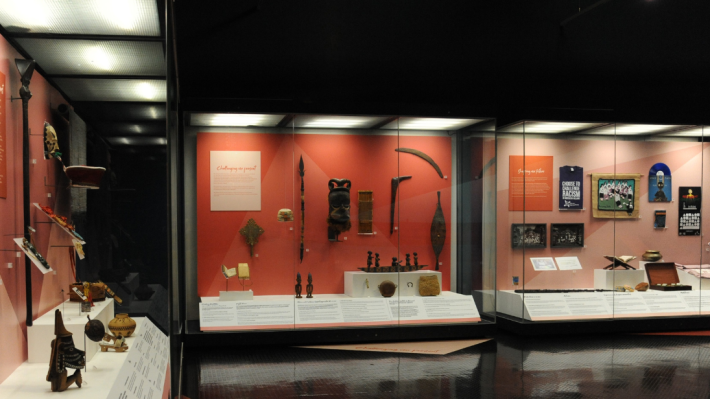
New exhibition embraces Decolonisation
'Inclusive Global Histories' represents a commitment to decolonisation, diversity and inclusion at Ulster Museum.
Explore the fascinating discovery of Chief Maqoma’s stick which arrived in Ireland back in 1873.
It tells the Black History perspective of the Frontier Wars in South Africa and opens up discussions on whether repatriations and restitution are a way forward. And if so, how and where do we begin to include the missing pieces of our oral histories into the tapestry of our collective history?
This event is an informative decolonisation conversation through a reading of the play 'The Rise of Maqoma' by Nandi Jola a two-hander, followed by a Q&A. It's an opportunity to examine a challenging period of history and our relationship with other parts of the world. This event allows for the exploration of issues including racism and activism.
What to know
Nandi Jola | About this event
After studying the Frontier Wars and Europe’s invasion of South Africa in the 18th century, the establishment of the Cape Colony and the bravery of the Xhosa Warriors, I visited Robben Island in 2023. For centuries, this has been the Island where people who were deemed dangerous have been kept away from society.
First, the island was occupied by people who had leprosy, where Irish nuns tended to them through their commitment and duty of religion. Later, the Island experienced the invasion of the British where it became a place where prisoners of war were sent to and kept. In the 1800s, during the building of the British Empire, native Africans known as the amaXhosa Warriors were sent to exile on Robben Island.
It was this island where Maqoma, uJongumsobomvu, the Chief and Commander of the amaJingqi or amaXhosa regiment forces during the Frontier Wars, lost his life whilst imprisoned in 1873 an act which changed South Africa’s history forever. This Play is an innovative retelling of an oral history recount in a body of work influenced by the discovery of Chief Maqoma’s cane at the National Museum of Ireland, the cane came to Ireland in 1873 and was donated to the Museum in 1880.
The language of colonisation and migration becomes changeable through the continuous challenging of the known whitewashed history and, most especially through opening up the conversations on repatriations and restitution for all those that experienced and continue to experience unjust recollections of their individual and collective history. The most important thing this body of work does is to effectively fill in the gaps within history and affords us a broader look into the past through the inclusion of notes that were successfully excluded to give a one dimensional view of a series of different periods within our history. The Rise of Maqoma is the beginning of a series of works by Nandi Jola that look at the history of artefacts using the Arts as a catalyst to open up conversations and awareness on the vast Oral History of Africans.